
Kelkoo Sales Tracking (KST) allows Kelkoo Group to measure the sales generated by the traffic we send to your website.
KST uses a first-party identifier to recognise visits originating from Kelkoo Group and connect them with subsequent purchases. This allows us to measure campaign performance and optimise the traffic we send to you.
How does Kelkoo Sales Tracking work?
Kelkoo Sales Tracking uses two main components:
Lead Tag
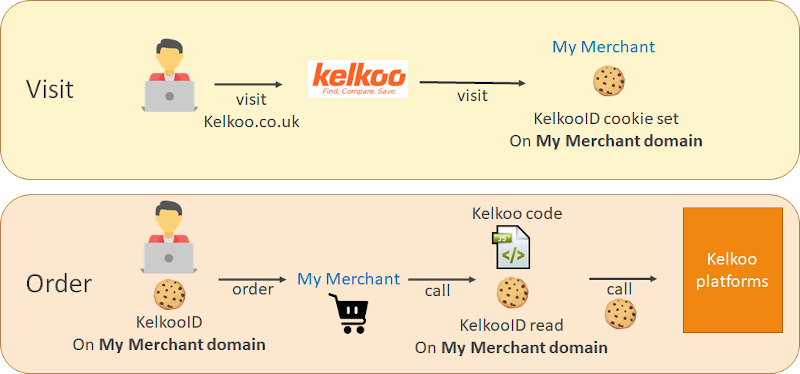
The Lead Tag is loaded when a user visits your website after clicking a Kelkoo Group ad.
The Kelkoo click contains a unique identifier in the kk URL parameter. The Lead Tag retrieves this identifier and, when the required consent has been obtained, stores it using first-party browser storage.
Because the identifier is stored on your website's domain rather than on a Kelkoo Group domain, it is considered first-party.
The stored identifier allows KST to recognise the original Kelkoo visit if the user returns to your website and completes a purchase later.
Conversion Tag
The Conversion Tag fires whenever an order is completed.
It sends the transaction information required by Kelkoo Group, such as:
-
the Order ID;
-
the Order Value;
-
the Kelkoo identifier, when available;
-
additional transaction information, depending on your implementation.
The Sales Tracking Tag should fire for every completed order, regardless of the traffic source responsible for the user's final visit.
Kelkoo Group then applies its attribution logic to determine whether the transaction should be attributed to Kelkoo traffic.
Attribution model
Kelkoo Sales Tracking uses a Kelkoo Channel Last Click attribution model with a 30-day conversion window.
How does attribution work?
When a user clicks a Kelkoo Group ad, KST stores the identifier associated with that visit.
If the same user completes a purchase within the following 30 days, the sale can be attributed to Kelkoo Group.
This remains the case if the user returns to your website through another channel before completing the purchase.
For example:
Day 1: User clicks a Kelkoo Group ad → visits your website → does not purchase
Day 5: User returns through an organic Google search → does not purchase
Day 10: User returns directly to your website → completes a purchase
In this example, Kelkoo Sales Tracking attributes the sale to Kelkoo Group, because the user clicked through Kelkoo within the previous 30 days.
Important
Kelkoo Sales Tracking attribution differs from the attribution used by Google Analytics or other analytics platforms.
For example, an analytics platform using a cross-channel last-click model may attribute the transaction above to another channel, while KST attributes it to Kelkoo Group.
These differences do not necessarily indicate a tracking issue; they simply result from different attribution methodologies.
Conversion window
The KST conversion window is 30 days.
A transaction can therefore be attributed to Kelkoo Group when it occurs within 30 days of a qualifying Kelkoo click.
After the 30-day period has expired, that click is no longer considered for attribution.
If another Kelkoo click occurs during the conversion window, the most recent qualifying Kelkoo click is used.
For more information about differences between KST and analytics platforms, see Understanding Differences Between KelkooGroup Reported Clicks in Google Analytics 4.
FAQs
Tag Loading: Does your technology require the tags to be loaded only once for SPAs, or should they fire with each new virtual page view?
Our lead tag is used to store the user id from the kk query parameter to a first party cookie. The goal of this is the correct attribution and measurement of the sales. It need to be loaded only once.
Performance: We've noticed that the tags inject into the head section with each virtual page load, potentially affecting site performance. Do you have guidelines for minimizing this impact?
The tag does indeed load a pixel asynchronously as a fallback to store the user id. As this is asynchronous this does not impact site performance.
Optimization: Are there specific measures or best practices you recommend for ensuring accurate and optimized tracking for SPAs? Additionally, are any changes or alterations to pixel codes necessary for SPA compatibility?
There is no optimization needed for SPAs, as we don't track the individual pages of products viewed by the end user. We do not use this tag for retargeting purpose.